The 6 P's of Personal Growth

A simple, repeatable process for navigating whatever life puts in front of you.

What Are the 6 P's of Personal Growth?

Life doesn't hand you a manual. It helps to have a process you can return to—for a difficult moment, an opportunity, or a success you want to understand and maintain. The 6 P's are a practical process for reflection and intentional action.

The 6 P's of Personal Growth — Pause, Pinpoint, Process, Plan, Practice, Progress — are that process. Created by Speaker, Author, and Trainer Jan Davidson, the 6 P's bring attention, understanding, ownership, direction, action, and review into one memorable process. They are research-informed educational tools, not a validated clinical treatment.

They run underneath every module of the EMBRACE Model — helping you work with life's hills and valleys. The P's form a returning rhythm, not a rigid staircase: revisit any P, or return to Pause when unsure. You do not need to write out all six every time.

1

Pause — Stop Before You React

Pause means stop. Interrupt the automatic response long enough to notice what needs your attention—a difficult moment or something worth appreciating.

A breath, a moment of stillness, or noticing your surroundings may help. These are options, not requirements. Pause offers an opportunity to choose; it does not guarantee calm or clarity, and necessary safety action must not wait.

What am I noticing right now?

2

Pinpoint — Identify What Needs Attention

Identify the dominant issue: WHAT needs attention now, WHY it matters, and HOW it appears. Start with what you observe and distinguish facts from assumptions.

Explore possible contributors beneath the visible “fruit.” There may be several roots; avoid assuming one ultimate cause or knowing another person’s motives. After success, examine the preparation, support, decisions, and conditions that may have helped.

What needs attention—WHAT, WHY, and HOW?

3

Process — Own Your Part and Find Your Direction

Process combines ownership without blame and direction. Name feelings, test assumptions, and ask what is yours to own. Then identify where you want or need to move.

Feel before fixing, without letting emotion make every decision. Feelings need not fully resolve before responsible action. Journaling, reflection, conversation, or appropriate support may help. Separate your part from other people’s responsibilities and organizational or system issues.

What is mine to own, and where do I want or need to move?

4

Plan — Choose a Realistic, Appropriate Step

Choose an action that fits the need, your role, and your circumstances. It may be small, a significant decision, timely escalation, a boundary, or continuing what already works. A plan need not always be different.

Make the action specific enough to use. Identify when and where you will act, what support is needed, and when you will review it. Some situations require prompt action; personal pacing does not remove those responsibilities.

What is my next honest, appropriate step?

5

Practice — Give the Plan a Real Opportunity

Put an appropriate plan into action across relevant situations. Rehearse a conversation, repeat a helpful routine, or use a cue to remember your response. With repetition, a response may become more automatic.

Give a reasonable plan enough practice to learn from it. One uncomfortable attempt does not necessarily mean the plan should change. Reassess sooner if it is harmful, unsafe, unsuitable, or produces serious unintended consequences.

What should I keep practicing or reassess?

6

Progress — Look for Meaningful Movement

Progress means evidence of meaningful movement toward the direction you identified. Compare what changed with what mattered: a clearer handoff, a respected boundary, a repaired conversation, or a success maintained.

Acknowledge effort, then examine the result. Trying, tracking, and receiving feedback help you learn; they alone do not prove progress. Celebrate what helps, continue useful practice, or adjust the plan. Your progress does not determine your worth.

What evidence shows meaningful movement, and what comes next?
How the 6 P's Work With the EMBRACE Model

The EMBRACE Model has seven modules — Evaluate, Maintain, Balance, Reach-Out/Release, Action, Connect/Commit, Empower — each addressing a different dimension of personal growth.

The EMBRACE modules identify WHAT we work on; the 6 P's are HOW we work through it. From Pause to Progress™ is the learning experience where participants practice the same process in real-life contexts.

The process stays consistent while the application changes. Return to it for challenges and successes, including maintaining something that is already working.

Research-Informed Connections

The framework has conceptual connections with research on attention, reflection, psychological flexibility, goal setting, practice, and feedback. Evidence for those ideas does not establish that the complete 6 P's program has been empirically validated or will produce a particular outcome.

  • Pause → Attention and mindful awareness
  • Pinpoint → Reflective questioning and checking assumptions
  • Process → Perspective, psychological flexibility, ownership, and direction
  • Plan → Goal setting and planning appropriate action
  • Practice → Repetition, cues, and learning from experience
  • Progress → Reviewing evidence and using feedback

The framework was created by Jan Davidson, a Speaker, Author, and Trainer who developed it from her own experience navigating loss — and from decades of professional practice helping others do the same.

Frequently Asked Questions About the 6 P's

What are the 6 P's of Personal Growth?

The 6 P's are Pause, Pinpoint, Process, Plan, Practice, and Progress—a returning process created by Jan Davidson for challenges, opportunities, and successes. Use them to notice, understand, own your part and direction, choose appropriate action, practice, and review meaningful movement.

How do the 6 P's relate to the EMBRACE Model?

The EMBRACE Model identifies WHAT we work on; the 6 P's provide HOW. From Pause to Progress is the learning experience for practicing the process across personal, workplace, and community contexts.

Can I use the 6 P's on my own?

Yes. Use them for personal reflection, guided support, workshops, or organizational learning. Revisit any P or return to Pause when unsure. This educational framework does not replace professional care, required safety action, or organizational responsibilities.

What evidence is behind the 6 P's?

The framework has conceptual connections with research on attention, reflection, psychological flexibility, goal setting, practice, and feedback. Those connections do not establish empirical validation of the complete 6 P's program or guarantee outcomes. It is a research-informed educational framework, not a clinical treatment.

Who created the 6 P's?

Jan Davidson — Speaker, Author, and Trainer — created the 6 P's as part of the EMBRACE Model. The framework was born from her personal experience navigating loss after her mother's passing, combined with decades of professional practice.

Bring From Pause to Progress to Your Group

Explore workshops and organizational learning experiences with Jan Davidson.

Explore Workshops

Take the 6 P's With You

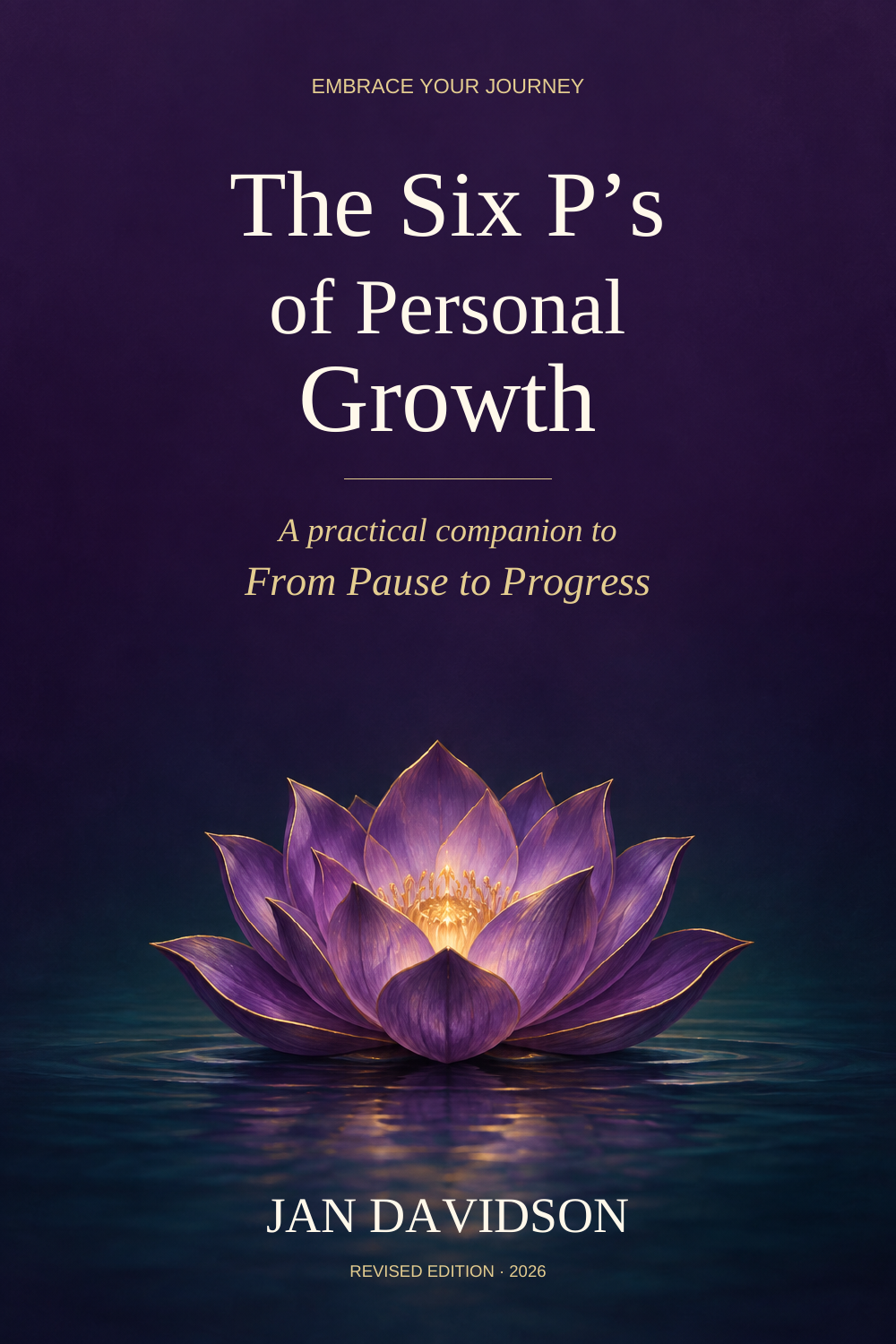
Explore the revised book, with Jan’s personal reflections, everyday examples, and space to consider your next honest step.

The Six P’s of Personal Growth by Jan Davidson, revised 2026 edition

A Process You Can Return To

The Six P’s of Personal Growth is Jan Davidson’s practical companion to From Pause to Progress. Explore Pause, Pinpoint, Process, Plan, Practice, and Progress through personal reflection, everyday examples, and questions you can use in your own life.

This fully revised edition makes room for grief and change, as well as opportunity, success, and new possibilities. Jan shares how the Six P’s became a life preserver in her own life: a familiar process that helps her feel grounded and present.

Includes guided reflection pages, a week of practice, a workshop companion, and a quick reference page. Read it independently or bring it to a From Pause to Progress learning experience.

$4.97 DIGITAL EDITION

40-page digital PDF · 6 × 9 inches · Personal-use edition

Buy Now with PayPal — $4.97 ✨

You'll be redirected to PayPal to complete your purchase securely.

Secure checkout via PayPal · PDF format · Works on any device

More Than Knowledge — A Practice

📖 A Clear Framework

The 6 P's explained in plain, warm language — no jargon, no overwhelm. Just a practical path you can actually follow.

🪷 A Personal Perspective

Jan shares what the process has meant in her own life, including the overlapping feelings of grief, relief, and guilt after her mother’s death.

✏️ Guided Exercises

Reflection prompts and exercises that help you apply each P to your own life — not hypothetically, but right now, today.

💡 Real-World Examples

Follow fictional examples involving relationships, work, new opportunities, and the lessons you can carry forward from success.

🌿 Permission to Go Slow

This isn't a sprint. The e-book honors your pace, your readiness, and your right to take one step at a time.

🪷 A Workshop Companion

Bring the book to From Pause to Progress, choose one real situation, and use the companion pages to turn your learning into practice.

This E-book Is for You If…

  • 🪷 You're navigating grief, loss, or a major life transition
  • 🪷 You feel stuck but aren't sure where to start
  • 🪷 You want a framework that's gentle and effective
  • 🪷 You're taking part in From Pause to Progress
  • 🪷 You want to understand what is helping you grow and build on it
  • 🪷 You believe in progress, not perfection
EMBRACE Your Journey

“The process is available for me to return to. It helps me feel grounded and present, especially when emotion is so strong that what I know seems harder to reach.”

— Jan Davidson, Speaker, Author, Trainer & Creator of the EMBRACE Model

Start Your Journey Today

Which P am I in, and what is my next honest step? Begin with one real situation and a process you can return to.

© 2026 Embrace Your Journey Now LLC. All rights reserved. This e-book is for personal use only. Reproduction, distribution, or sharing of this material without written permission is prohibited. The 6 P's of Personal Growth and the EMBRACE Model are the intellectual property of Jan Davidson.

Ready to Start Your Journey?

The 6 P's come alive in the EMBRACE Your Journey Workbook — 170 pages of guided exercises, real-life case studies, and tools you'll actually use. Or start with the e-book for a focused introduction.

Get the Workbook Explore the EMBRACE Model