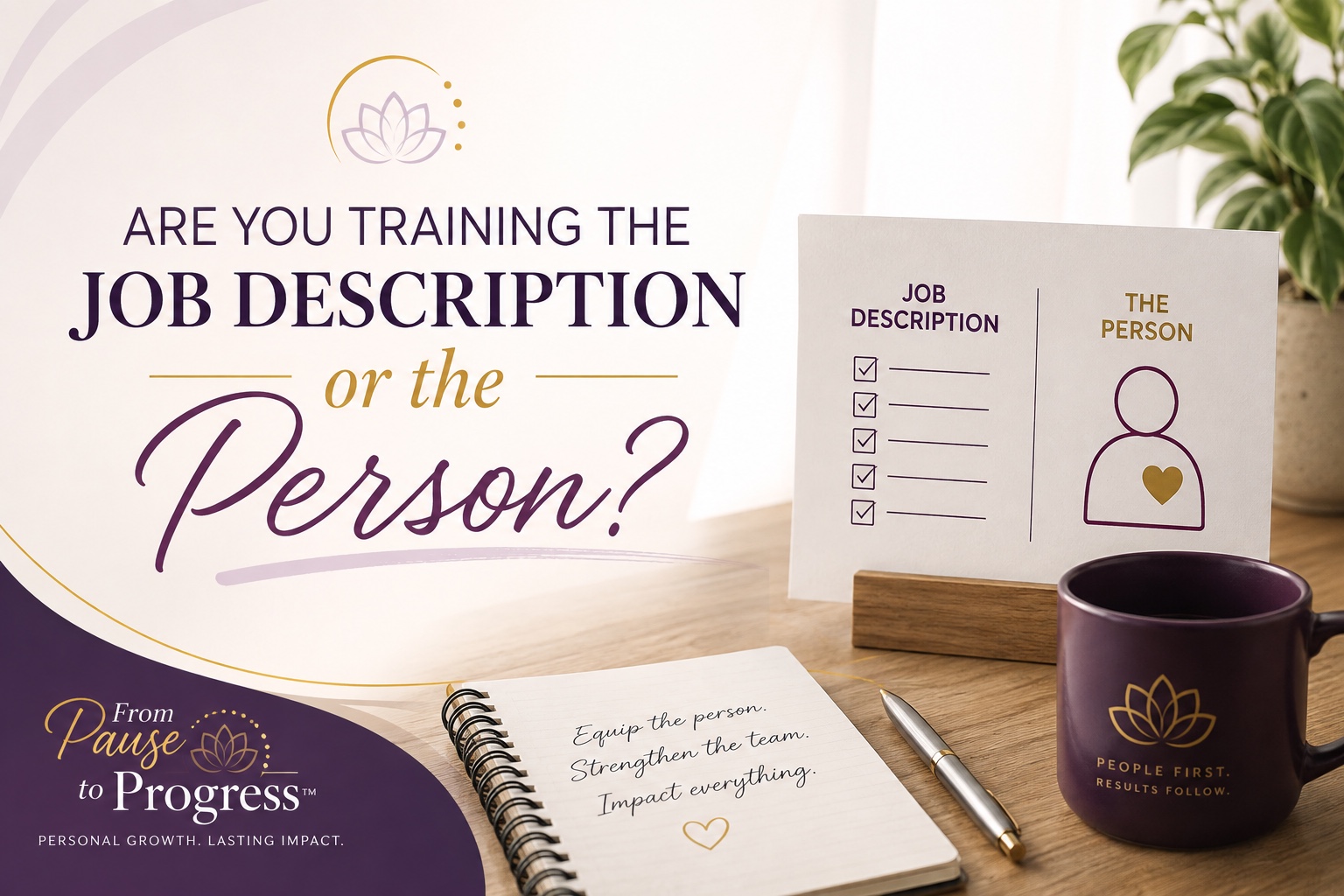
When we hire someone, we usually start with a job description.
The responsibilities.
The expectations.
The skills required.
The outcomes we need.
And when it comes time to train them, we often do the same thing.
We train the job description.
We teach the systems, procedures, policies, technology, and processes someone needs to perform the position.
And we absolutely should.
But there is something the job description doesn't tell us.
Who is the person doing the job?
There Is a Person Behind the Job Description
Employees don't leave the rest of themselves in the parking lot when they walk into work.
They bring their experiences.
Their responsibilities.
Their stress.
Their relationships.
Their disappointments.
Their hopes.
Their worries.
Their goals.
And sometimes, things happening at work travel home with them too.
The person travels both ways.
That doesn't mean the workplace needs to become a therapy room.
It means there is value in equipping people with practical tools that help them pause, recognize what is happening, process it, make an intentional plan, practice a different response, and continue moving forward.
Because when we strengthen the person, we don't stop strengthening the employee.
We strengthen both.
What Are We Equipping the Person to Do?
Organizations spend tremendous amounts of time and resources teaching employees what to do.
But there is another question worth asking:
What are we teaching people to do when life gets in the way of what they know to do?
What happens when frustration walks into the meeting?
When something at home makes concentration difficult?
When a difficult interaction at work stays on someone's mind long after the workday ends?
When an employee knows the appropriate response—but in the moment struggles to access it?
Information matters.
Skills matter.
Technical training matters.
But information alone does not always create transformation.
Sometimes people need a practical process for moving from knowing to doing.
That is where whole-person development becomes important.
The goal isn't to eliminate life's hills and valleys.
The goal is to equip people with tools they can use while navigating them.
A Moment of Reflection
Think about the training your organization currently provides.
Does most of it teach people how to perform the responsibilities listed in their job description?
If so, that isn't wrong.
It's necessary.
But there may be another opportunity sitting right beside it.
An opportunity to equip the person who performs those responsibilities.
Because the job description tells us what needs to get done.
The person is the one who has to do it.
And when people have practical tools to pause, pinpoint what is really happening, process it, plan their next intentional move, practice new responses, and recognize their progress, those tools don't stay in a training room.
They travel.
From work to home.
And from home back to work.
An Invitation
As organizations think about employee development, perhaps the question isn't whether we should stop training for the job.
Of course we shouldn't.
Perhaps the better question is:
Are you training for the job description—and for the person?
From Pause to Progress™ was designed to help organizations do both—giving people a practical, repeatable process they can use in real situations, at work and beyond it.
Jan Davidson
Speaker • Author • Trainer
Creator of the EMBRACE Model™
From Pause to Progress™
🪷 Beside you on the journey. 🪷
#WholePersonDevelopment #EmployeeTraining #WorkplaceWellbeing #FromPauseToProgress